
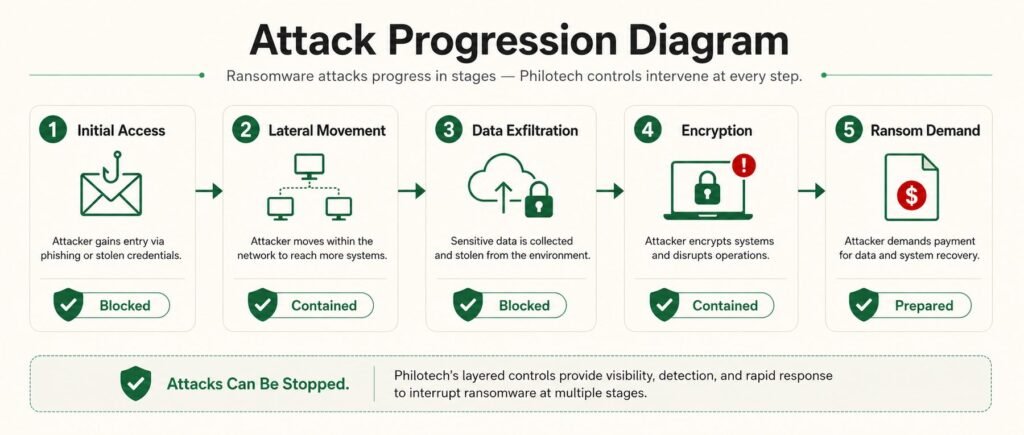
The question isn’t whether your security can prevent every attack. It’s whether the attackers gain leverage.
Ransomware is often discussed as a cybersecurity issue, or worse, as a generic data-loss scenario. In reality, it is neither. Ransomware is an intentional business interruption and extortion attempt, carried out by attackers whose goal is simple: encrypt systems, disrupt operations, and demand payment to restore access.
For small and mid-sized firms, the real risk isn’t the malware itself. It’s whether the attackers gain leverage. When ransomware succeeds, it isn’t because the attack was impossible to stop. It’s because the firm couldn’t recover quickly and confidently on its own.
Why Small and Mid-Sized Firms Are Now a Primary Target
Ransomware has shifted from a small number of attacks on large enterprises toward high-volume attacks on small and mid-sized businesses. Automated scanning tools let attackers check large numbers of networks at once for unpatched systems or misconfigured cloud permissions, and “ransomware-as-a-service” kits mean an attack no longer requires deep technical skill on the attacker’s part.
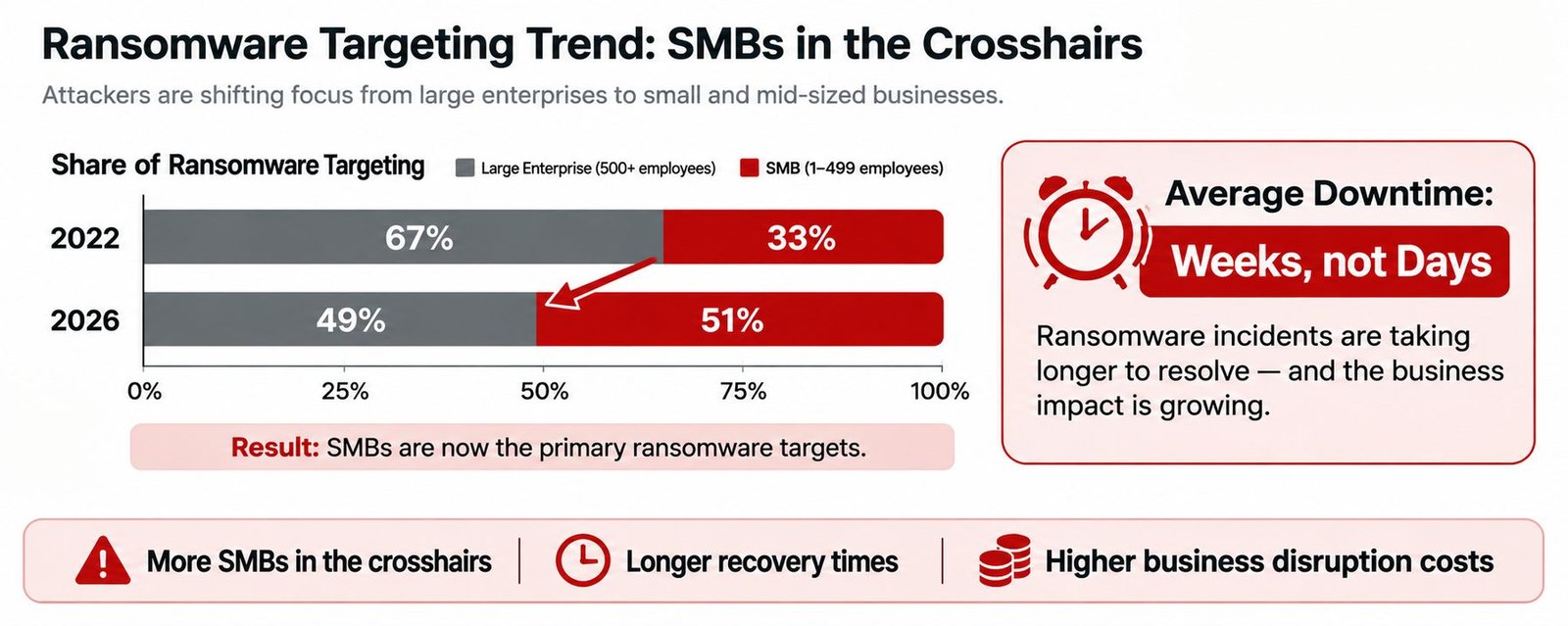
Industry research consistently shows that ransomware plays a role in the large majority of reported SMB breaches, well above its share of large-enterprise breaches, and that average downtime after a ransomware attack now stretches into weeks rather than days. For a small or mid-sized firm, that kind of extended downtime is often close to a worst-case outcome.
Attackers have also moved beyond simple encryption toward “triple extortion”: encrypting data, threatening to leak what they stole, and in some cases launching denial-of-service attacks against a company’s public-facing systems to increase pressure. The goal in every case is the same: take away your ability to operate normally until you pay.
Ransomware Is About Leverage, Not Just Encryption
At its core, ransomware works by removing access to critical systems and data. The attackers assume the business cannot function without those assets and will therefore pay to regain access.
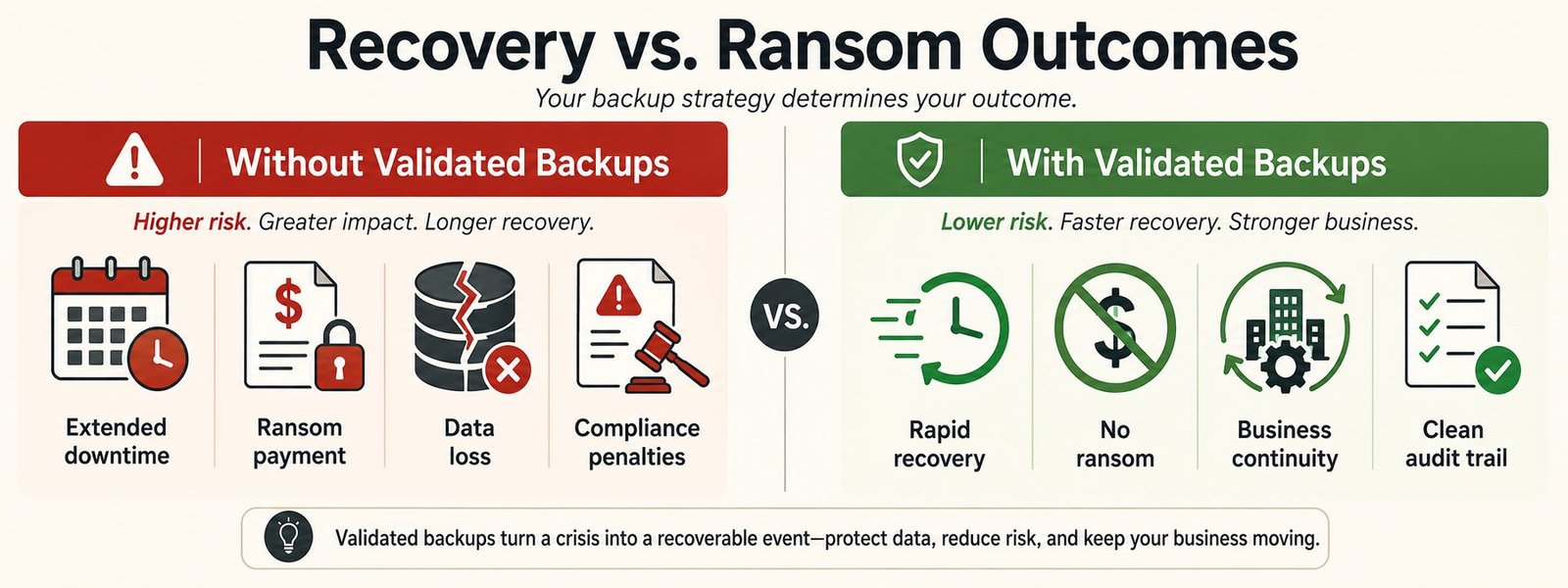
That leverage disappears when a firm has validated, tested backups and a recovery process that works under pressure. In those cases, ransom demands become noise. The firm restores systems, resumes operations, and ignores the extortion attempt entirely.
This distinction is critical, and often misunderstood.
Cybersecurity Is the First Line of Defense
Preventing ransomware from executing in the first place remains the best outcome. That’s why cybersecurity controls, including endpoint protection, monitoring, identity security, and threat detection, are the first line of defense.
Philotech’s cybersecurity services are designed to reduce the likelihood that ransomware can gain a foothold at all. More importantly, we actively monitor client environments for indicators of compromise and suspicious behavior. In many cases, Philotech identifies and responds to issues before clients are even aware something is wrong. That early detection is often the difference between a contained security event and a full-scale ransomware incident.
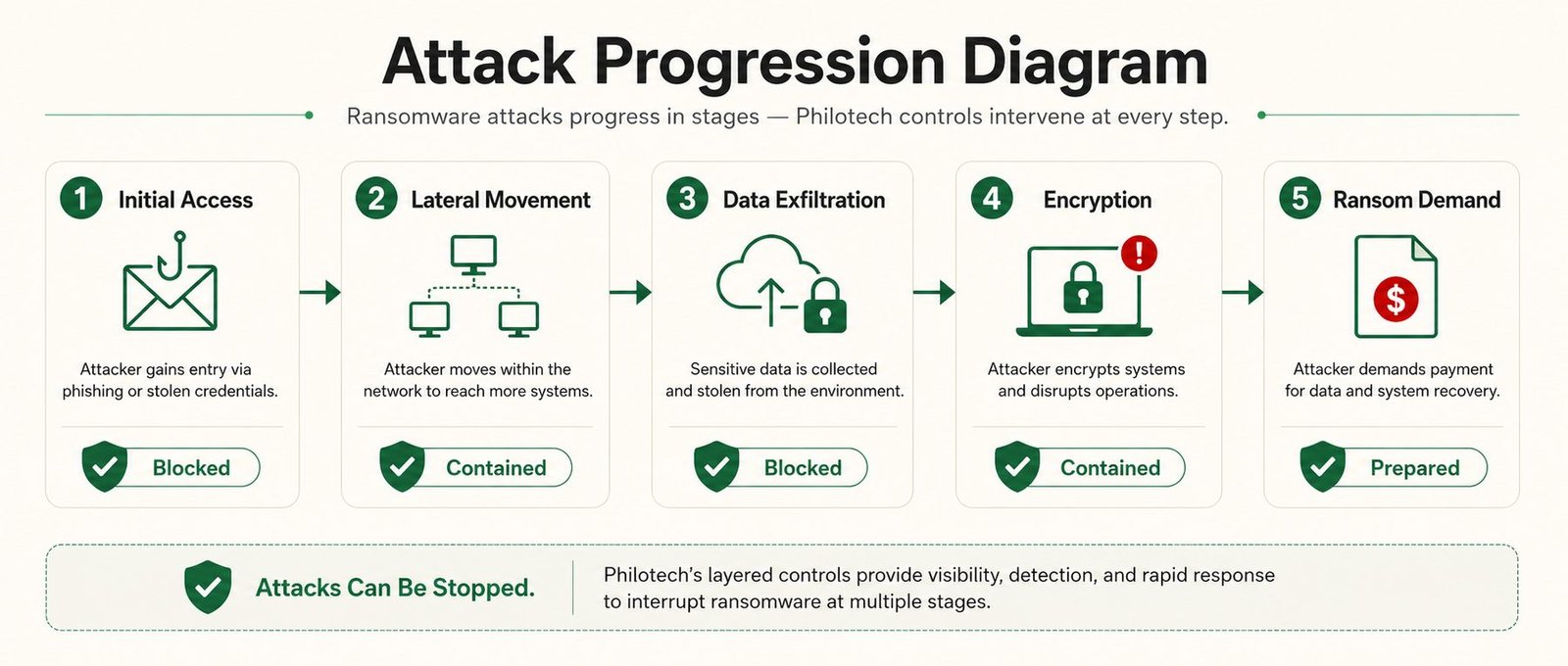
When Ransomware Gets In, Recovery Takes Over
No security strategy assumes breaches are impossible. Mature firms plan for containment and recovery, not just prevention.
If ransomware does execute, the focus immediately shifts to business continuity, not negotiation. This is where many firms struggle, not because they lack backups, but because their recovery process has never been validated under real conditions. Backups that haven’t been tested don’t remove leverage. Recovery plans that exist only on paper don’t restore operations.
Firms should also be aware that ransomware incidents increasingly trigger mandatory reporting obligations. Depending on the industry and jurisdiction, organizations may be required to notify regulators, law enforcement, affected individuals, or all three within defined timeframes. Having an incident response plan that accounts for these obligations avoids compounding a security crisis with a compliance failure.
Why Backups Change the Power Dynamic
Validated backups allow a firm to:
- Restore systems without paying a ransom
- Control recovery timing and sequencing
- Resume client service with minimized disruption
- Avoid engaging with criminals altogether
This is where ransomware stops being an existential threat and becomes a managed incident.
Philotech designs backup and disaster recovery processes that are customized to how the firm actually operates, not vendor defaults. Critical systems are prioritized, recovery timelines are realistic, and restores are tested regularly so recovery is predictable when it matters most.
Insurers are also paying closer attention to this. As underwriters increasingly ask for proof of baseline security controls before writing a policy, firms that can document tested backups and a working recovery process are typically better positioned for coverage and for claims if an incident occurs.
Proactive Response, Not Panic Calls
In a ransomware-ready environment, recovery doesn’t begin with a frantic phone call. It begins automatically.
Because Philotech proactively monitors client environments, we’re often already responding by the time a client notices an issue. Containment, recovery validation, and system restoration follow defined procedures designed to get the business operational again as quickly and cleanly as possible.
The objective is simple: restore operations on your terms, not the attacker’s.
The Bottom Line
Ransomware is not about lost files. It is about control.
Firms that rely solely on prevention, or assume backups are enough, leave themselves exposed to extortion. Firms that pair strong cybersecurity with validated disaster recovery remove the attacker’s leverage entirely.
Philotech provides both: cybersecurity to stop ransomware when possible, and recovery processes that let you ignore ransom demands and keep operating when it matters most.