
Many organizations treat compliance as a seasonal scramble, a sprint to satisfy auditors or renew an insurance policy, followed by months of drift until the next deadline. The problem with this approach is that the gap between audits becomes a period of real risk. Policies decay, configurations shift, and the security posture that passed muster in March may not reflect reality in September.
Compliance built into daily operations keeps you protected and audit-ready every day, not just on audit day.
For small and mid-sized firms in healthcare, legal, finance, and benefits administration, this shift is no longer optional. Frameworks like HIPAA, PCI DSS, and SOC 2 now demand continuous, provable security, and the firms that treat compliance as an operational baseline, rather than a project, are the ones that satisfy regulators, retain clients, and recover fastest when something goes wrong.
The Core Frameworks: What They Actually Require
Before mapping solutions to requirements, it helps to understand what each framework is really asking for. While the details differ, the goal is the same across all three: protect sensitive information, prove you’re doing it, and demonstrate you can keep operating if something breaks.
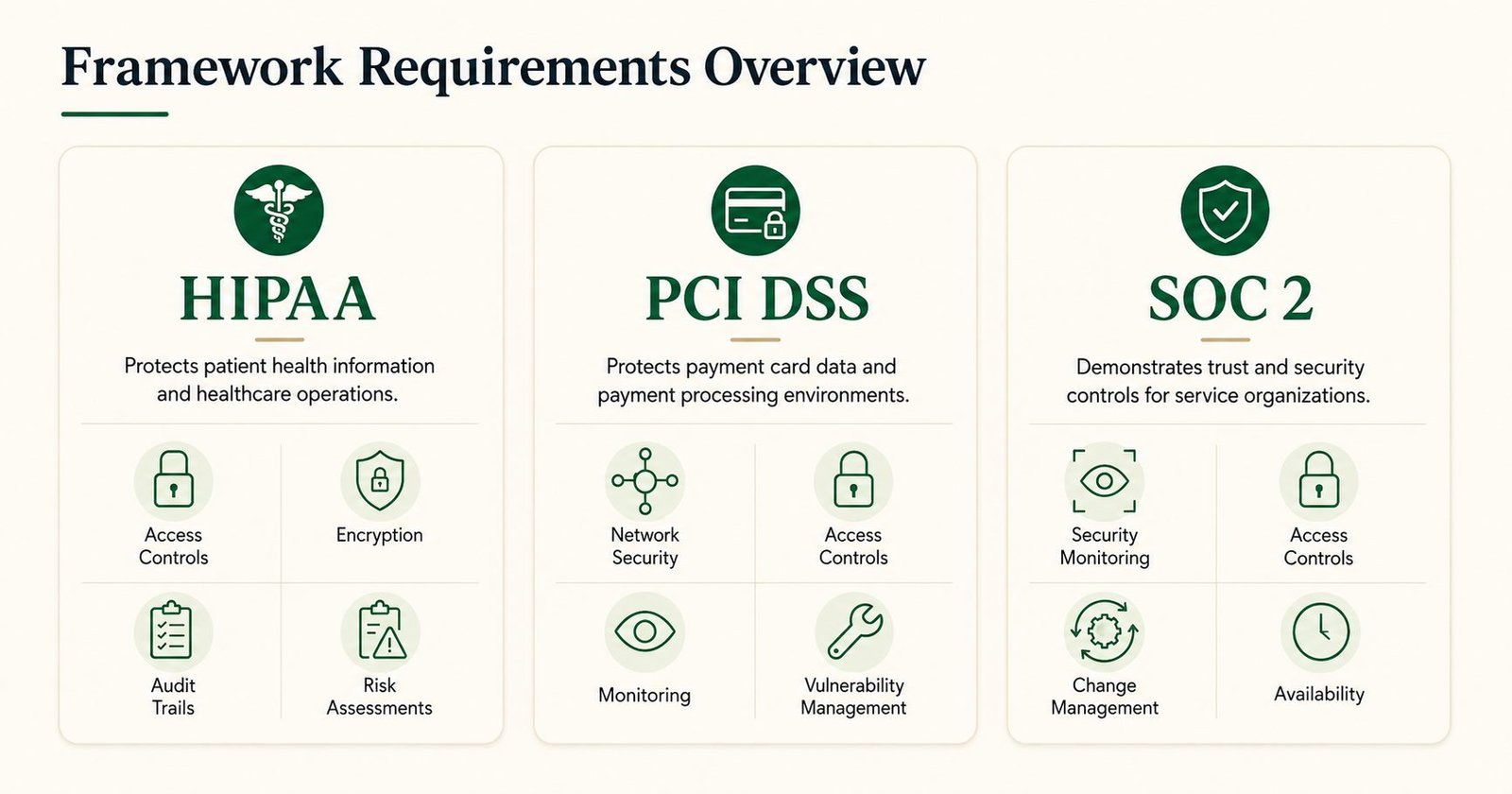
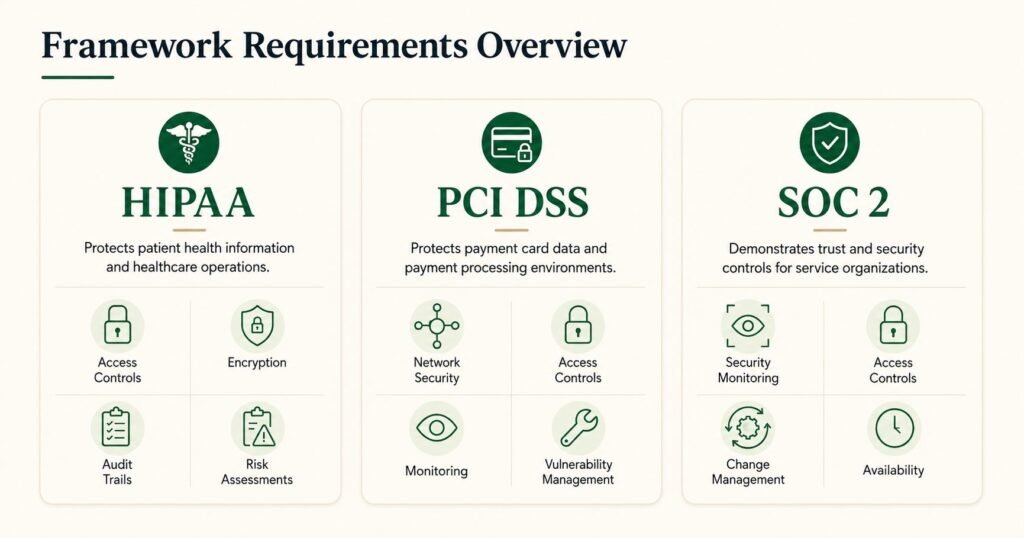
HIPAA (Health Insurance Portability and Accountability Act): Mandatory for any organization that handles Protected Health Information (PHI), including “business associates” like IT partners, accountants, and benefits administrators. Compliance centers on strict access controls (only authorized personnel can reach patient data) and encryption of data both at rest and in transit.
PCI DSS (Payment Card Industry Data Security Standard): Applies to any entity that processes, stores, or transmits credit card information. The focus is on securing the cardholder data environment through network segmentation, continuous monitoring, and encryption.
SOC 2 (System and Organization Controls): A reporting framework built on Trust Services Criteria, covering Security, Availability, Confidentiality, Processing Integrity, and Privacy. SOC 2 is not a law, but it is increasingly a commercial requirement. Enterprise clients routinely require SOC 2 reports as proof that a service provider maintains rigorous internal controls before signing a contract.
Understanding which frameworks apply is the first step. The harder part is building a technical environment that satisfies them continuously, not just at the moment of the audit.
Mapping Controls to Compliance Requirements
Moving from manual tracking to automated enforcement means aligning specific technical capabilities with the pillars of each framework. Here is how the PhiloSecure Elite and PhiloWork Elite stacks address the unique requirements of each.
HIPAA: Protecting PHI and Access Integrity
HIPAA requires that only authorized personnel can access patient data, and that all data at rest and in transit is encrypted.
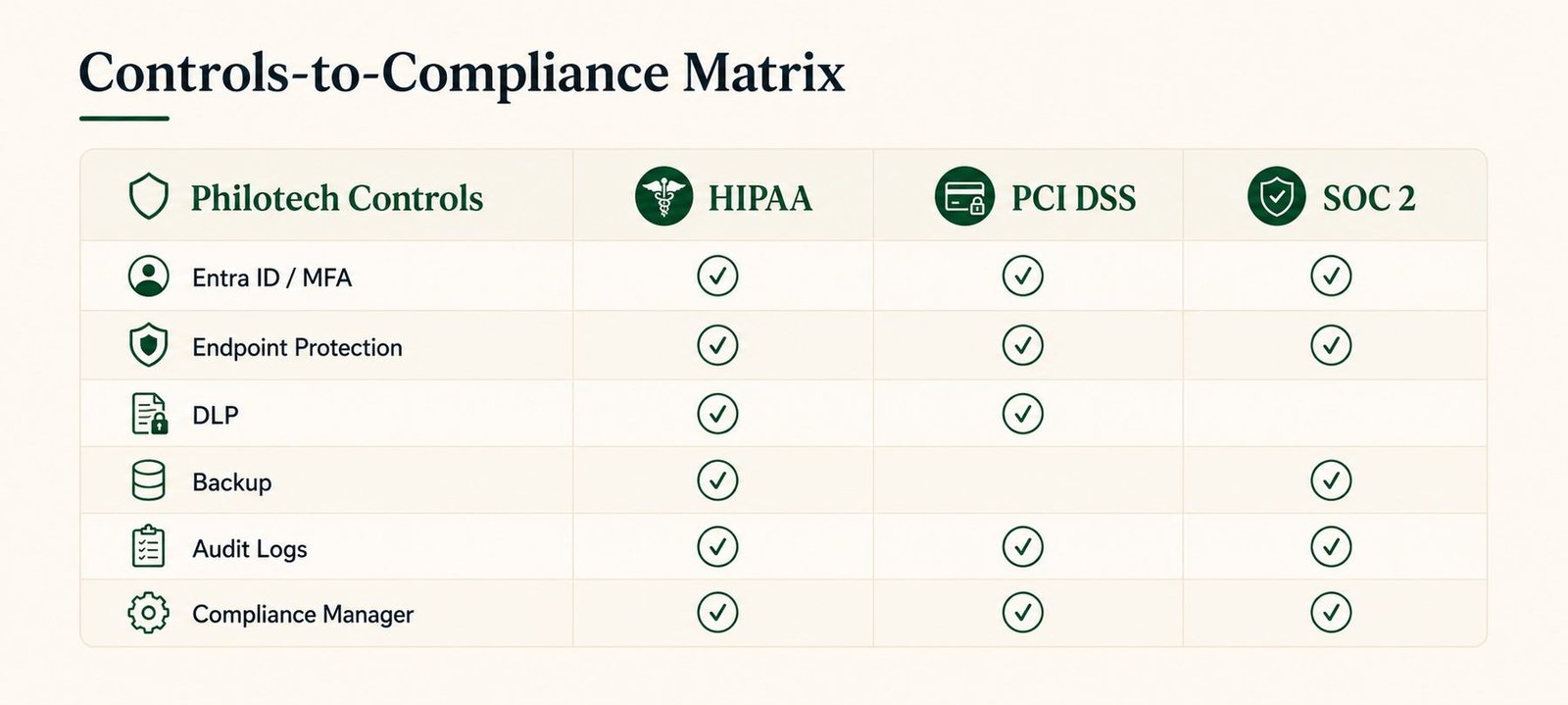
PhiloSecure Elite: Implements Microsoft Entra ID and Conditional Access to enforce least-privilege access. Users reach only the data their role requires, under conditions the organization defines (managed device, recognized location, MFA verified). BitLocker encryption is deployed across all endpoints to ensure PHI remains unreadable if a device is lost or stolen.
PhiloWork Elite adds: Audit (Standard) logs that track exactly who accessed specific data sets, when, and from where, satisfying HIPAA’s requirement for detailed access monitoring and providing a ready-made evidence trail for investigations.
PCI DSS: Securing the Transaction Environment
PCI standards focus on protecting cardholder data through network segmentation, encryption, and continuous monitoring.
PhiloSecure Elite: Deploys Bitdefender GravityZone endpoint protection and MESH email security to protect against malware and phishing attempts targeting transaction portals. Data Loss Prevention (DLP) policies identify and block the unauthorized transmission of credit card number patterns.
PhiloWork Elite adds: Centralized policy management ensures that all security configurations, including firewalls, endpoint protection, and encryption settings, are active and consistent across every machine in the environment. This prevents the “configuration drift” that causes PCI failures: the slow, invisible divergence between what the policy says and what the machines are actually doing.
SOC 2: Demonstrating Operational Excellence
SOC 2 is evidence-based. An organization must prove that its stated security policies are actually being followed in daily operations, not just written down in a handbook.
PhiloSecure Elite: Establishes Secure Score dashboards that function as a real-time security posture metric. Auditors can see a verifiable, up-to-date picture of the organization’s security health rather than relying on point-in-time documentation.
PhiloWork Elite adds: Compliance Manager visibility, a dashboard that maps technical configurations directly to SOC 2 Trust Services Criteria. This automates the evidence-gathering process that typically consumes weeks of staff time before an annual audit.
From Audit Scramble to Continuous Baseline
The traditional audit cycle (scramble to prepare, pass the audit, drift until next year) creates exactly the kind of gap that frameworks are designed to prevent. A compliance-ready posture replaces that cycle with a continuous baseline: pre-configured settings that ensure every device and user identity meets a minimum security standard from the moment they connect.
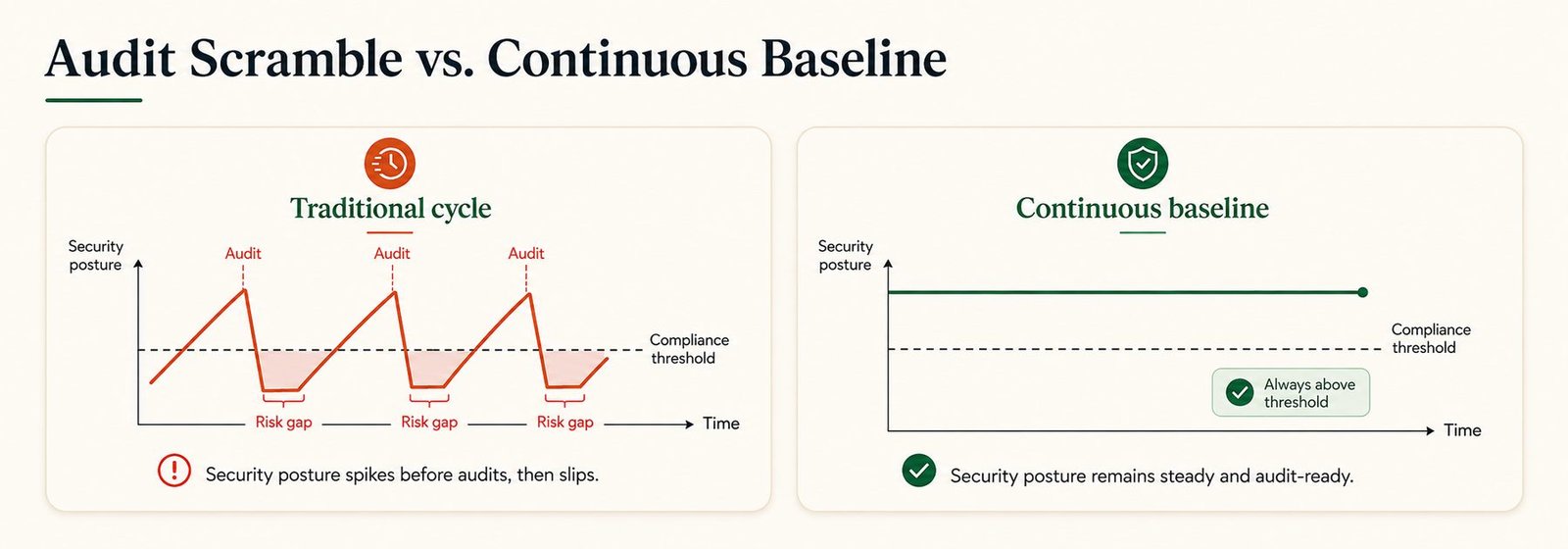
Philotech implements this through compliance-ready coverage aligned with SOC 2, ISO 27001, and HIPAA as a standard operational state. The distinction matters: instead of spinning up a project every time an audit approaches, the organization’s security controls are always on, always enforced, and always producing the logs and evidence an auditor would ask for.
This is also where compliance becomes a continuity strategy rather than just a regulatory exercise. An organization that maintains continuous compliance baselines is, by definition, one that has working access controls, tested backups, monitored endpoints, and documented processes. Those are the same capabilities that determine whether a firm recovers from a ransomware event in hours or in weeks.
Information Protection and Governance
Knowing where sensitive information lives, and preventing it from leaving the controlled environment, is a requirement across all three frameworks.
Data Loss Prevention (DLP): DLP policies monitor data movement across email, cloud storage, and endpoints. If an employee accidentally attempts to share a file containing Social Security numbers or credit card digits outside the organization, the system intervenes before the data leaves.
Document labeling: Microsoft Purview Information Protection allows documents to be labeled based on sensitivity. A “Highly Confidential” label ensures that encryption and access restrictions follow the file regardless of where it is stored or forwarded, preventing unauthorized printing, forwarding, or downloading.
Backup as a compliance control: Continuity is impossible without data availability. Philotech implements hourly backup frequencies with long-term retention, ensuring recovery points are recent enough to be useful and old enough to satisfy legal discovery and archival requirements.
Streamlining the Audit Itself
Even with the right technical controls in place, the administrative burden of an audit can be significant. PhiloWork Elite reduces that burden by centralizing the evidence-gathering process.
Audit-ready logs: Automatically maintained records of user and admin activity, essential for HR investigations, legal inquiries, or regulatory reviews.
eDiscovery: Tools to search for and place legal holds on relevant data during proceedings, a key requirement for organizations in highly regulated sectors like healthcare and finance.
Compliance Manager dashboards: A centralized view that maps the organization’s technical configurations to specific global standards, letting leadership see exactly how their environment satisfies each requirement, and where gaps remain.
Common Questions
Is SOC 2 necessary if it’s not legally required?
SOC 2 is not a law, but it is increasingly a condition of doing business. Enterprise clients and larger partners routinely require SOC 2 reports before signing vendor contracts. For growing firms, having a SOC 2-ready posture opens doors that a firm without one cannot walk through.
What’s the difference between PhiloSecure and PhiloWork for compliance?
PhiloSecure focuses on the security controls themselves: threat detection, endpoint protection, backup and recovery. PhiloWork includes everything in PhiloSecure plus full management of the Microsoft 365 environment, identity governance, and the compliance reporting and audit tooling that turns security data into evidence.
Is compliance only a concern for large enterprises?
No. Small and mid-sized firms are increasingly held to the same standards, by regulators, by insurers, and by the clients and partners who require proof of security maturity as a condition of the relationship.
Compliance as a Competitive Advantage
A current, verified security posture, not a six-month-old report, wins more clients, better insurance rates, and faster recovery.
When compliance is continuous rather than episodic, it stops being a cost center and starts being a business asset.
The firms that treat compliance as a foundation rather than a finish line are the ones that keep their attention where it belongs: on the work that matters, not on the next audit deadline.