
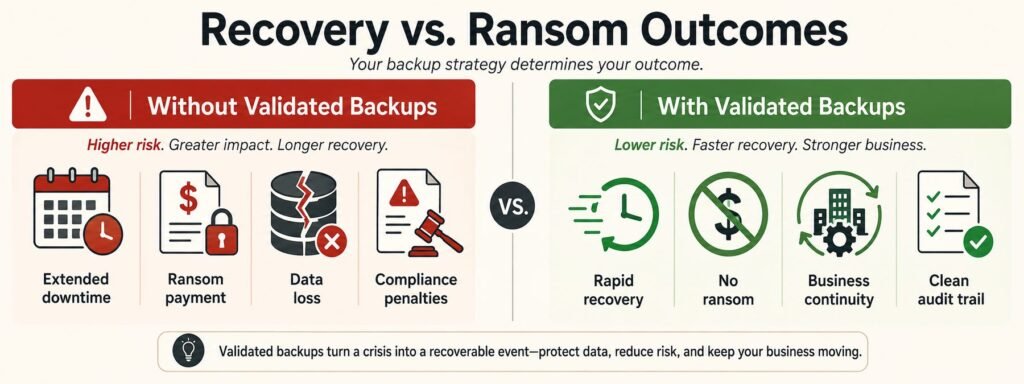
In the landscape of modern digital operations, data is the lifeblood of your business. Yet, for many Small and Medium-Sized Businesses (SMBs), the systems designed to protect that data are fundamentally flawed. While most organizations believe they are protected because they have a “backup” in place, the harsh reality often only surfaces during a crisis. Recent data reveals a startling disconnect between perception and reality: only 19% of mid-level managers report strong confidence in their organization’s cyber readiness, despite 45% of C-level executives saying they feel “very confident”, according to the Bitdefender 2025 Cybersecurity Assessment Report.
The tragedy of a broken backup is that the failure rarely happens at the moment of the disaster; it happens months prior, remaining undetected due to a lack of rigorous oversight, misconfiguration, or outdated strategy. To bridge this gap, businesses must first understand the financial and operational stakes involved in today’s hyper-connected environment.
The Economics of Failure: The 2025 Reality
To understand why a functional backup is non-negotiable, one must look at the escalating cost of recovery. For a modern SMB, the cost of being offline is no longer just a technical inconvenience; it is a financial catastrophe. According to the IBM Cost of a Data Breach Report 2025, the average cost of a data breach in the United States has reached a record high of $10.22 million.
When a system fails, the costs ripple through every facet of the organization:
- Cost of Downtime: research from Corporate Technologies indicates that critical system outages can cost small businesses as much as $10,000 per hour, encompassing unproductive labor costs, diminished brand reputation, and potential regulatory penalties.
- Workforce Strain and Burnout: in the 2025 Cybersecurity Report, 49% of cybersecurity professionals report feeling burned out due to the constant pressure to monitor, triage, and respond to threats in real time.
- The High Cost of Silence: the research found that 58% of respondents were told to keep a breach confidential, a practice that multiplies reputational damage when discovered and leads to steep regulatory fines.
- Complexity and Management Overload: 31% of IT professionals cite “complexity” as their biggest challenge, which creates gaps and alert fatigue that hide backup failures until it is too late.
While these systemic pressures are sobering, the root causes of data loss often trace back to three specific “silent killers” within an organization’s backup architecture.
The Hidden Anatomy of Backup Failure
Most SMBs discover their backup is broken only when they are staring at a ransomware note. To build a resilient organization, you must recognize the structural flaws that plague standard backup routines.
1. The Lack of Disaster Recovery (DR) Orchestration
A backup is merely a collection of data; Disaster Recovery is a coordinated process. As environments grow more complex, IBM reports that breaches involving data distributed across multiple environments now cost an average of $5.05 million due to recovery complexity. Without an orchestrated plan to restore applications in the correct priority order, your business remains at a standstill even if the data is technically “saved.”
2. The “Set It and Forget It” Fallacy
The most common reason backups fail is a lack of testing. It is a dangerous misconception to assume that a “Success” notification in your software equals a recoverable file. Modern threats are increasingly stealthy; attackers are now more likely to “log in, instead of breaking in” using stolen credentials. If your backup processes aren’t regularly verified through live restoration drills, you are operating on hope rather than a plan.
3. The Local-Only Trap
Many organizations still rely on local external drives as their primary backup destination. While these offer fast recovery for minor deletions, they represent a single point of failure. The Assessment Report reveals that 84% of major attacks now leverage Living Off the Land (LOTL) techniques. These attacks manipulate trusted utilities already in your system, like PowerShell or RDP, to quietly disable defenses and encrypt local backups alongside primary data.
4. The Cloud Security Fallacy
There is a pervasive and dangerous myth that data stored in the cloud is automatically “safe” because the provider manages the infrastructure. While cloud giants excel at service availability, ensuring the data can be served to you, they do not provide comprehensive data protection. Most cloud providers operate on a “Shared Responsibility Model.” They keep the lights on, but they do not regularly back up your specific data for the purposes of recovering from ransomware or accidental deletion. If a user deletes a critical directory or a sync client uploads encrypted ransomware files, the cloud provider will simply “sync” those changes across your environment.
True resilience requires a managed approach that handles the technical execution of these layers.
Solving the Resilience Gap with Philotech
Philotech moves beyond traditional IT support by providing proactive, enterprise-grade solutions.
Continuous Cloud & Endpoint Protection
We move away from the “nightly backup” model, which leaves a massive vulnerability. Instead, we provide automated, hourly backup frequencies for both cloud environments and individual endpoints, ensuring that even the most recent work is preserved.
Rapid Recovery Workflows
Minutes matter in a crisis. Our infrastructure is built for granular recovery, allowing for restoration of specific files, entire machine images, or booting machine images to a virtual machine to sustain uptime while primary hardware is being serviced.
Disaster Recovery Orchestration
We eliminate the manual scrambling of traditional DR. Our orchestration platform automates the recovery sequence, ensuring that security permissions, network configurations, and application dependencies are handled systematically.
If your primary network is compromised, your recovery data remains untouched. Philotech manages backups in a segregated environment, physically and logically removed from the primary network.
However, even the most orchestrated recovery is only effective if it is integrated with a proactive defense layer to stop threats before they compromise your data.
The Security Synergy: Prevention and Recovery
A backup strategy must work in tandem with advanced threat detection.
- Shrinking the Attack Surface: 68% of security leaders agree that reducing the attack surface by disabling unnecessary tools is critical. Philotech eliminates the footholds attackers use to reach your data.
- Automated Remediation: the team monitors for the early signs of malicious behavior. When an attack is detected, the system blocks the process and initiates an automated restoration, often before the user even realizes an attack occurred.
FAQ: Modern Data Protection in 2025
Is a cloud sync like OneDrive a backup?
No. Sync tools are not backups. If a file is encrypted by ransomware, the encrypted version syncs to the cloud immediately. Philotech uses versioned, image-based backups isolated from sync folders and stored off-site, away from bad actors.
How often should we test our restores?
In 2025, industry standards suggest automated integrity testing daily and full-scale drills at least quarterly. IBM found that identification and containment times under 200 days cost $1.14 million less than longer lifecycles.
What is an “Immutable” backup?
It is a digital vault where data is “locked.” It cannot be overwritten or deleted, making it the only 100% effective defense against ransomware that targets backup files.
Conclusion: Moving from Protection to Resilience
A backup is not a product you buy; it is a result of consistent, verified processes. If you haven’t tested your restores, if your data lives only in one building, or if you lack a plan to bring it all back to life using a specific process, your backup is likely broken.
The transition to a managed, orchestrated model ensures that when the next crisis hits, you aren’t just hoping for the best, you are executing a proven plan. By aligning with the technical excellence of Philotech and the security intelligence of Bitdefender, your business can ensure total digital resilience in 2026 and beyond.